Culture is an important part of art as it inspires the artist to create and influences how the viewer in turn relates to the art itself. One such instance of cultural influence in the arts is Frida Kahlo’s My Grandparents, My Parents, and I (Family Tree) in which she depicts her family’s heritage. While at first glance one might observe this painting to be that of a simple family tree with a few artistic choices made here and there, upon closer inspection you may come to find that the painting holds a much greater significance.
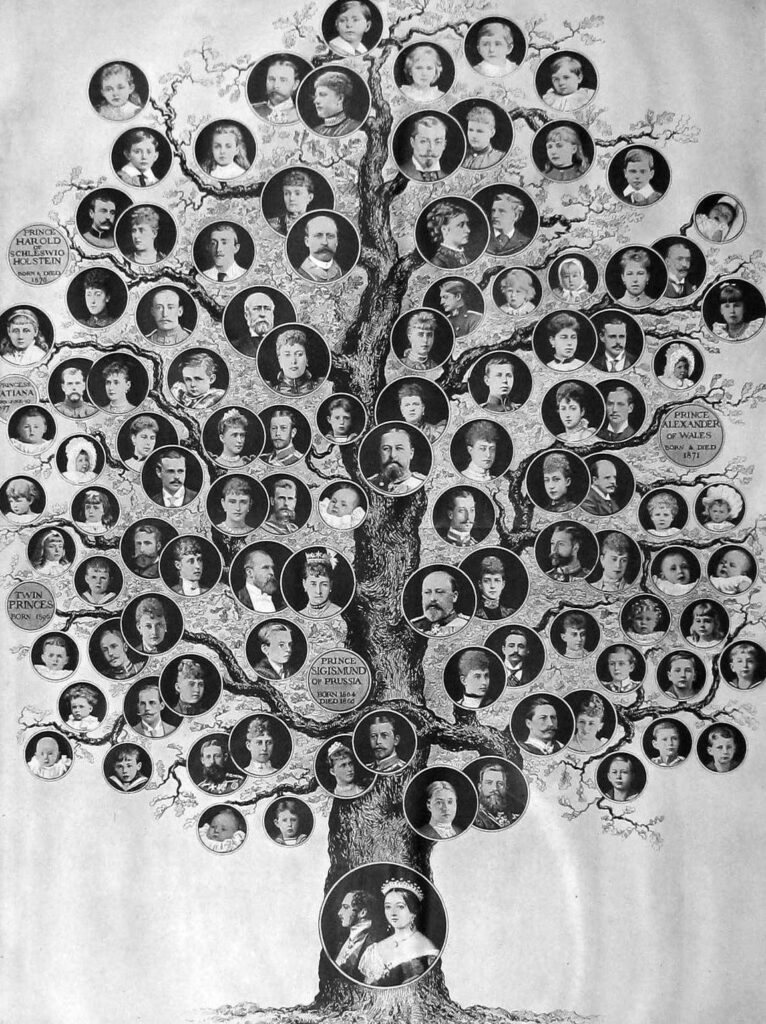
When you hear the words “Family Tree” you may think of a literal tree or perhaps you think of a long descending diagram containing a picture of the person, their name, date of birth, and death if applicable, as well as a their relations to other members of their family. Frida Kahlo chose to take a less literal approach when creating this piece and simplified her family tree down to just her immediate family; this includes both sets of grandparents as well as her own parents. A shiny red ribbon is used to represent how they are all related and is actually held in the middle by a depiction of Frida as a young child. The background of the painting shows a dry desert like area by the ocean near a small house, naturally one would assume this id Frida’s childhood home where she grew up. The stark landscape contrasts immensely with the formal attire that the people in the painting are wearing as well as the ribbon that connects them. This contrast seems to represent Frida’s heritage more than her family tree does, as she is half European half Mexican. The land represents her Mexican heritage while the attire her family wears represents her European heritage.
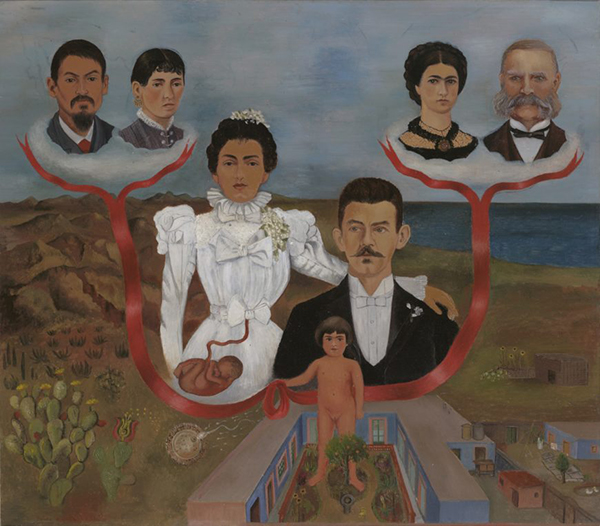
Although many people during Frida’s time would have scorned her for being of mixed race, Frida seems proud of her heritage as she depicts her family standing tall and refined while Frida herself shows no shame by standing in the nude. Take note that she is the only figure in the painting that can actually be seen making contact with the landscape, showing that she is what connects her family to this place in a sense. One of the unique things about this painting is that Frida actually draws herself twice, once as the young child holding the ribbon and again as the unborn fetus depicted by her mother. Below the unborn child there is also a picture of a sperm fertilizing an egg, seemingly connected to the pollen drifting from a near by flowering cactus. In a sense this is another way Frida is showing how her heritage connects her to the land but it also goes to show how she is not afraid of some of the things that people in European society might be ashamed or shy of.
In the end Frida’s heritage is something she clearly feels strongly about and she uses these feelings to influence her paintings, similarly to romanticism styled paintings. She is the result of two cultures mixing and wants everyone to know that she isn’t ashamed of who she is.
Leave a Reply