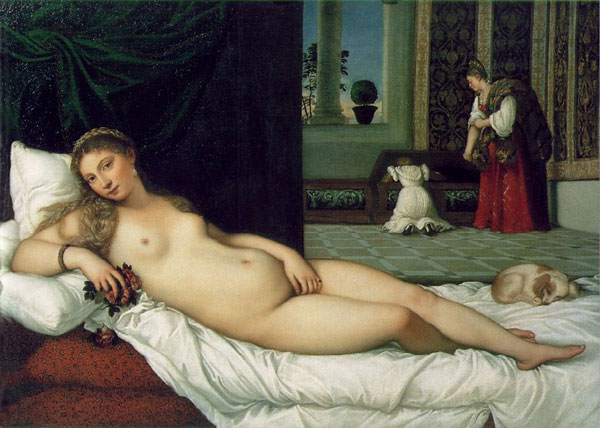
The ideals of art in the Italian Renaissance vary differently from those of both the Northern Renaissance and Mannerist era. The painting “Venus of Urbino”, by Titian, is a great example of what ideals were important during the Italian Renaissance. The piece itself depicts a young woman laying nude on a bed as two female attendants gather her belongings from what appears to be a cassoni, or large chest that holds items from her wedding such as her dowry, so we can assume this woman has just recently be wed. Although we don’t know who she is for sure it is believed that the woman in the painting represents the Roman goddess of love, Venus, which would make sense for the time period as art made during the Italian Renaissance often depicted scenes from Greek and Roman mythology. She is meant to represent the ideals of female beauty for the time period, from her lack of clothes to the way she’s laying on the bed all of it helps to add to the idea of elegance and seduction. Another ideal that can be interpreted from this painting is humanism, or the idea of what it means to be human. During the Italian Renaissance humanism was more focused on one’s potential to do good for themselves and their society. If we think about this idea while looking at “Venus of Urbino” you may see how the woman marriage was for the good of her family. One could also infer that her beauty is for the pleasure, or good, of her husband.
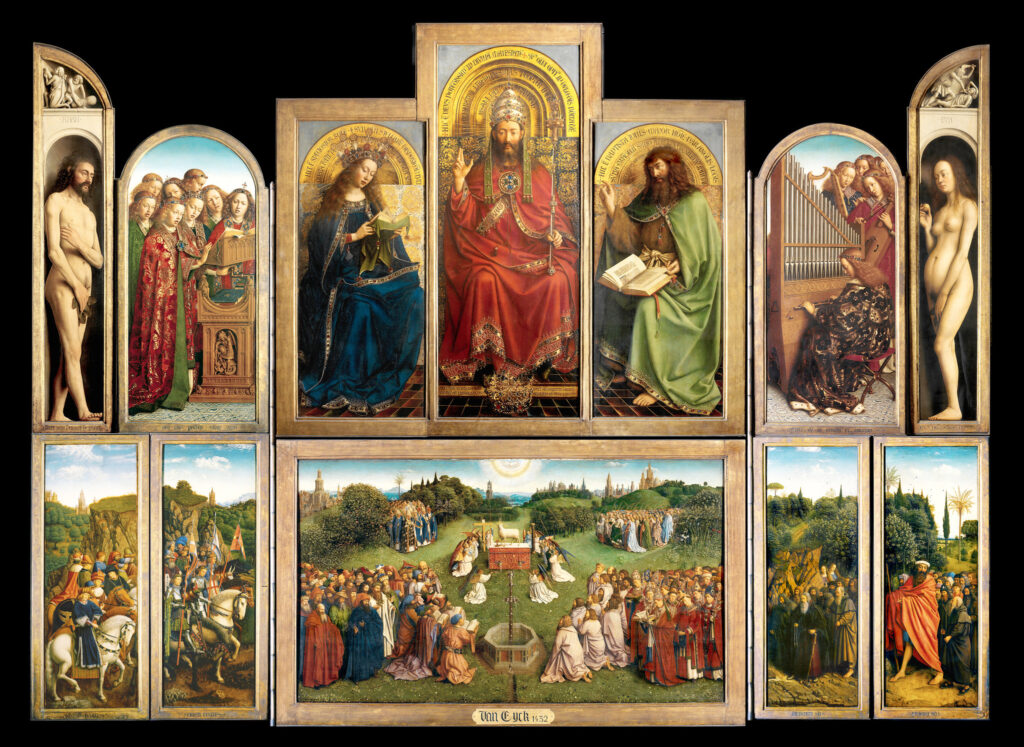
In comparison the Northern Renaissance’s ideals were mainly focused on the religion of the time, Christianity. Art made during this time period often used realism and were heavily detailed. This art was meant to help redirect society and push them to accept the ideals of Christianity. To help illustrate these ideals take a look at the “Ghent Altarpiece” by Jan van Eyck. Made up of 12 wooden panels it contains many scenes of religious origin such as people adoring a lamb, the Annunciation, a pair of donners worshiping two of the saints, and many more. This altarpiece would have been displayed in a church and helped to reinforce the religious beliefs of those who saw it. Similar pieces would have been made to display in domestic settings such as a living or bed room, that way you were always reminded of your beliefs even outside of the church.

Finally, on the complete opposite side of the spectrum we have Mannerism who’s ideals were much more free flowing. Mannerism was all about making art just because you could. To give you an idea of what I mean lets view the “Madonna of the Long Neck” by Parmigianino. Before even looking at the painting we already know this woman’s neck is going to be elongated based off of the title alone but that’s not the only part of her that is highly exaggerated, her entire body is shaped like a diamond, she has wide hips, tiny feet, and a small head. The baby in her lap, presumedly Christ, is large for an infant, his body takes up almost the entirety of the Madonna’s lap. Their distorted posing is not anatomically correct and is practically impossible to achieve. Even the angel to their left bares this whimsical stance as he lightly holds a vase, much larger than his own head, with the tips of his fingers.
In conclusion the ideals of the Italian Renaissance were different from the ideals of the Northern Renaissance and the ideals of Mannerism were completely different from either of them.
Leave a Reply